The federal universal service charge rate is 42.0% for October to December 2026, up from 38.8%: the FCC's limit on the line item and how T-Mobile, Verizon and AT&T bill it
The FCC set the universal service contribution factor for October through December 2026 at 42.0%, up from 38.8% in July through September. That rate is the ceiling for the federal universal service line item on phone bills this quarter: the FCC's notice of September 14, 2026 says carriers may not recover through that line item more than 42.0 percent of the interstate telecommunications charges on a customer's bill. On October 24, 2026, Verizon listed its Federal Universal Service Charge at 42% and AT&T listed its Federal Universal Service Fee at up to 42.0%.
- FCC factor, October to December 2026
- 42.0% (Public Notice DA 26-946, released September 14, 2026)
- Previous quarter
- 38.8% for July to September 2026 (DA 26-546)
- Same quarter a year earlier
- 38.1% for October to December 2025 (DA 25-840)
- FCC limit on the bill line item
- No more than 42.0% of the interstate telecommunications charges on a customer's bill, during the fourth quarter of 2026
- Verizon
- Federal Universal Service Charge: 42% of the interstate and international telecom charges, varying quarterly
- AT&T
- Federal Universal Service Fee: a monthly cost recovery fee of up to 42.0%
- T-Mobile
- Federal and State Universal Fund Assessment, charged per line; T-Mobile's page gives no percentage
- Next factor (January to March 2027)
- Not yet published on October 24, 2026
Figures above were read from the FCC public notices and from Verizon's, AT&T's and T-Mobile's own pages on 2026-10-24. See sources.
The universal service factor by quarter
The FCC's Office of Managing Director announces a new factor before each quarter. The fourth-quarter 2026 notice says the factor "will be 0.42 or 42.0 percent", and it covers revenues projected for "October 2026 through December 2026". Each notice calls the factor proposed; it says that if the Commission takes no action within 14 days of release, the projections and the factor "shall be deemed approved by the Commission."
| Quarter | Factor | FCC notice | Released | Projected program cost | Projected interstate and international revenue |
|---|---|---|---|---|---|
| Oct-Dec 2025 | 38.1% | DA 25-840 | Sept 15, 2025 | $2.153410 billion | $7.870473 billion |
| Jan-Mar 2026 | 37.6% | DA 25-1026 | Dec 15, 2025 | $2.060770 billion | $7.604471 billion |
| Apr-Jun 2026 | 37.0% | DA 26-218 | Mar 16, 2026 | $2.022700 billion | $7.553337 billion |
| Jul-Sep 2026 | 38.8% | DA 26-546 | June 12, 2026 | $2.003130 billion | $7.221914 billion |
| Oct-Dec 2026 | 42.0% | DA 26-946 | Sept 14, 2026 | $2.026190 billion | $6.909925 billion |
Why the factor rose: less revenue to spread the cost over
The factor is a ratio. The notice says the FCC calculates it from "total projected quarterly costs" of the universal service programs divided by contributors' projected interstate and international end-user telecommunications revenues, net of projected contributions. By our arithmetic from the figures in the notices:
- From the third to the fourth quarter of 2026, the cost to be collected rose 1.2%, from $2.003130 billion to $2.026190 billion, while the projected revenue fell 4.3%, from $7.221914 billion to $6.909925 billion.
- Compared with October to December 2025, the cost to be collected was 5.9% lower, but the projected revenue was 12.2% lower, so the factor still went from 38.1% to 42.0%.
- The fourth-quarter 2026 factor is 3.2 percentage points above the third quarter, or 8.2% higher.
The fourth-quarter notice also says the FCC's Wireline Competition Bureau told the Universal Service Administrative Company to apply $69 million in unused funds to the Schools and Libraries program and $56 million to the Rural Health Care program, which "reduces the fourth quarter 2026 contribution factor to a level below the expected contribution factor based on USAC’s filings."
The FCC limit on the line item
Carriers pay into the fund and may pass the cost to customers in a separate line item. The fourth-quarter notice says "carriers may not markup federal universal service line-item amounts above the contribution factor." It then states the limit for this quarter: carriers may not "recover through a federal universal service line item an amount that exceeds 42.0 percent of the interstate telecommunications charges on a customer’s bill."
The same sentence appears in each quarterly notice with that quarter's rate: 38.8 percent for July to September 2026 and 37.0 percent for April to June 2026. The limit is a percentage of the interstate telecommunications charges on the bill, not of the whole bill.
How T-Mobile, Verizon and AT&T name and apply it
| Carrier | Name on the carrier's page | Rate stated | Applied to | How the carrier describes it |
|---|---|---|---|---|
| T-Mobile | Federal and State Universal Fund Assessment | No percentage stated; varies quarterly with the FCC factor | "a monthly fee per line"; some plans include taxes and fees in the plan price | Listed under T-Mobile fees and charges, not under government taxes |
| Verizon | Federal Universal Service Charge | 42%, as of October 1, 2026 | The interstate and international telecom charges | "Verizon charges, not taxes or government imposed fees" |
| AT&T | Federal Universal Service Fee | Up to 42.0% (postpaid) | Not stated on the fee schedule | "not a tax or charge which the government requires AT&T collect" |
T-Mobile
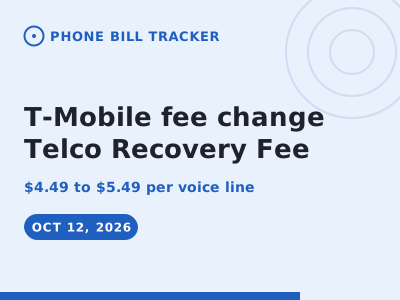
T-Mobile's bill support page lists a "Federal and State Universal Fund Assessment" in its T-Mobile fees and charges section. It says: "The rate of this monthly charge can vary quarterly based on the USF contribution factor established by the Federal Communications Commission." It adds that "T-Mobile charges a monthly fee per line to recover the cost of these contributions" and that "There are different assessment rates applicable to various services (e.g., International calls)." The page gives no percentage or dollar amount. It also notes: "Some T-Mobile plans include recurring monthly taxes and fees in the service plan price." T-Mobile's Terms and Conditions list Federal or State Universal Service fees among its surcharges, which it describes as T-Mobile charges, not government taxes.
Verizon
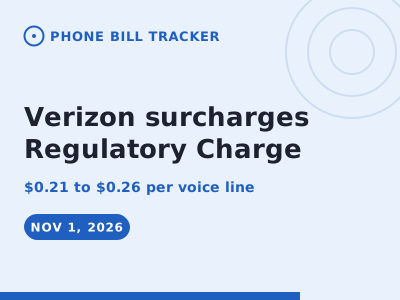
Verizon's Important Plan Information page states the rate as of October 1, 2026: a Federal Universal Service Charge of "42% of the interstate and international telecom charges; varies quarterly based on FCC rate". The same paragraph says taxes, other governmental charges and Verizon surcharges together "can add between 16% and 58%" to standard monthly access and other charges, and that Verizon Home Internet (Wireless) is not subject to these charges. Verizon's surcharges page describes the Federal Universal Service Charge as recovering charges "imposed on us by the government to support universal service" and says "these surcharges are Verizon charges, not taxes or government imposed fees." Verizon's other surcharges, including the Administrative and Telco Recovery Charge rising on November 15, 2026, are covered in our Verizon price increase 2026 record.
AT&T
AT&T's Mobility Fee Schedule lists the Federal Universal Service Fee for postpaid consumer service as "A monthly cost recovery fee of up to 42.0%". It says the fee helps AT&T recover its required contribution to the fund, and that AT&T "will update these Fees within a reasonable time period after it receives notice of any changes enacted by federal, state and/or local government." The schedule does not say what the percentage is applied to. The AT&T PREPAID section of the same schedule lists no federal universal service fee. A State Universal Service Fee, in the states and Puerto Rico that the schedule lists, is shown separately at 0.32% to 18.39%, or $0.72 to $1.35 per line.
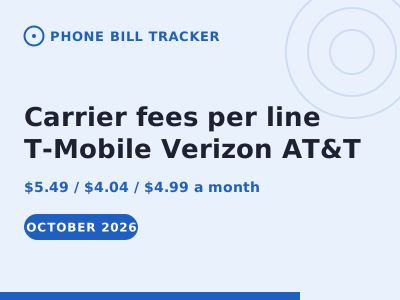
The per-line fees that do not change with the FCC factor are compared on our page on carrier fees per line.
How a percentage becomes dollars on a bill
The table below uses Verizon's rule as Verizon states it: the percentage times the interstate and international telecom charges. None of the three carriers' pages that we read states what share of a plan counts as interstate and international, so the dollar amounts in the first column are examples only, not the share of any real plan.
| Interstate and international telecom charges on the bill (example) | At 38.8% (Jul-Sep 2026) | At 42.0% (Oct-Dec 2026) | Change |
|---|---|---|---|
| $5.00 | $1.94 | $2.10 | +$0.16 |
| $10.00 | $3.88 | $4.20 | +$0.32 |
| $20.00 | $7.76 | $8.40 | +$0.64 |
| $30.00 | $11.64 | $12.60 | +$0.96 |
When the next rate is due
The factor for January to March 2027 had not been published on October 24, 2026. Last year's first-quarter notice, DA 25-1026, was released on December 15, 2025, 17 days before the quarter began; the other 2026 notices were released on March 16, June 12 and September 14. We will add the first-quarter 2027 figure when the FCC releases it.
This page is general information, not legal, tax or financial advice; how the charges apply depends on the plan, the carrier and the state.
What we could not confirm
- The share of a T-Mobile, Verizon or AT&T plan that each carrier treats as interstate and international. We read T-Mobile's bill support page and Terms and Conditions, Verizon's Important Plan Information and surcharges pages, and AT&T's Mobility Fee Schedule; none states it.
- The percentage or dollar amount T-Mobile charges. Its bill support page says the rate varies quarterly but gives no figure.
- What AT&T applies its "up to 42.0%" to. The fee schedule does not say.
- Whether the FCC took any action on the fourth-quarter factor after the notice. We did not find a revised notice; the FCC's own HTML pages refused our automated requests, so we relied on the notice PDFs.
- Whether T-Mobile Home Internet or AT&T home internet bills carry a federal universal service line item. The pages we read cover wireless service.
Questions
What is the federal universal service charge on my phone bill?
How is the federal universal service charge calculated?
What is the federal universal service charge at AT&T?
Why did the federal universal service charge increase?
Does it apply to international calls?
Sources
- Fourth quarter 2026 factor of 42.0%, cost and revenue projections, line-item limit - FCC Public Notice DA 26-946, released September 14, 2026 (PDF), read 2026-10-24
- Third quarter 2026 factor of 38.8% - FCC Public Notice DA 26-546, released June 12, 2026 (PDF), read 2026-10-24
- Second quarter 2026 factor of 37.0% - FCC Public Notice DA 26-218, released March 16, 2026 (PDF), read 2026-10-24
- First quarter 2026 factor of 37.6% - FCC Public Notice DA 25-1026, released December 15, 2025 (PDF), read 2026-10-24
- Fourth quarter 2025 factor of 38.1% - FCC Public Notice DA 25-840, released September 15, 2025 (PDF), read 2026-10-24
- Federal and State Universal Fund Assessment - T-Mobile Support: Your bill and what's impacting it, read 2026-10-24
- Surcharges, including universal service fees - T-Mobile Terms and Conditions, read 2026-10-24
- Federal Universal Service Charge at 42% as of October 1, 2026 - Verizon Support: Important Plan Information, read 2026-10-24
- What Verizon's surcharges are for - Verizon Support: Government taxes and fees and Verizon mobile surcharges, read 2026-10-24
- Federal and State Universal Service Fees - AT&T Mobility Fee Schedule, read 2026-10-24
Source links are not affiliate links. This page is general information, not legal, tax or financial advice.